
The story behind the park
Park Güell began as a private project. The industrialist Eusebi Güell commissioned Antoni Gaudí to design a residential estate on a hillside above Barcelona, inspired by the idea of a garden city with houses set in landscaped grounds. Gaudí designed roads, viaducts, a market hall, a large square and the entrance buildings. Only a few houses were built, and the estate did not succeed as a housing development. It later became a public park.
Park Güell is one of the components of the UNESCO World Heritage property “Works of Antoni Gaudí”, together with other buildings by the architect in and around Barcelona.
Sources: UNESCO World Heritage Centre: Works of Antoni Gaudí (opens in a new tab); Park Güell official website: World Heritage Site (opens in a new tab).
Entrance pavilions
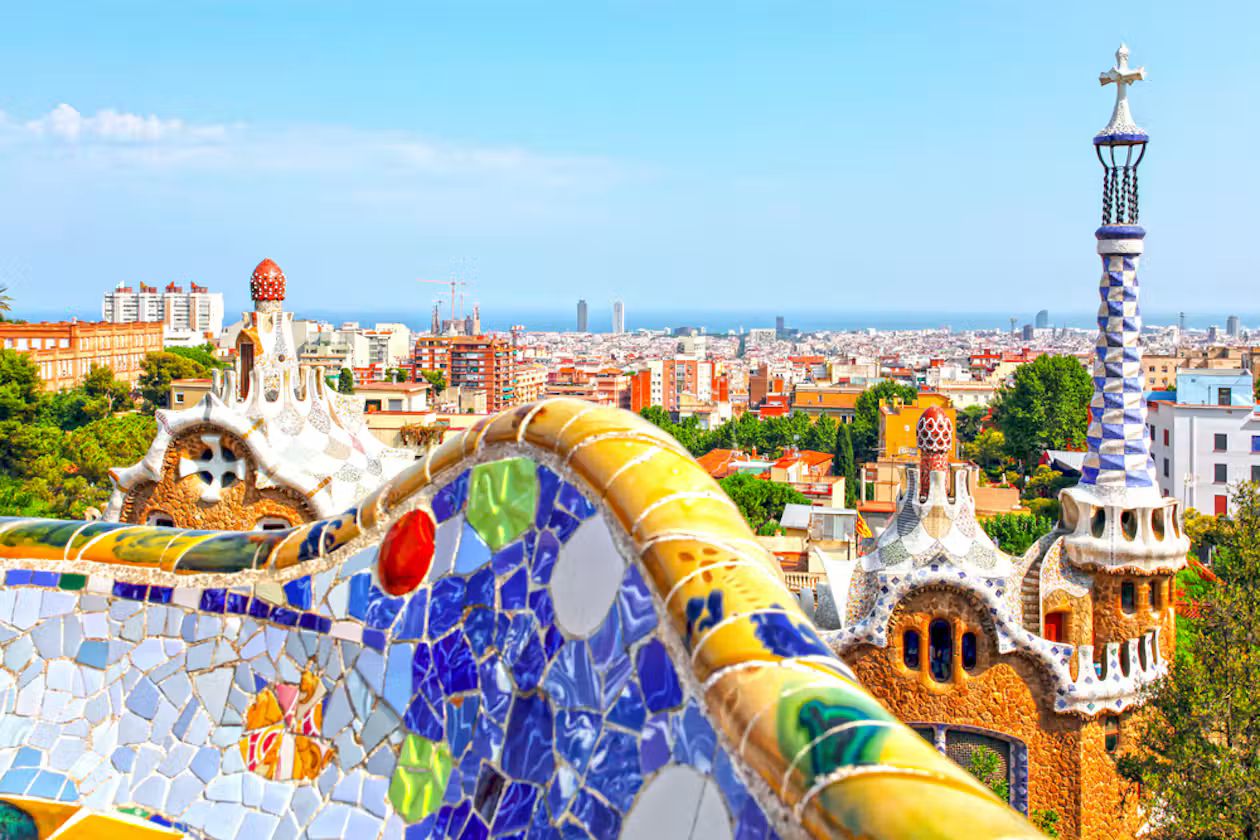
Two pavilions flank the main gate on Carrer d’Olot. With their undulating walls and roofs covered in ceramic pieces, they look like buildings from a fairy tale. One of them, Casa del Guarda, was the porter’s lodge and hosts an exhibition about the park. Check whether your option includes it.
Dragon Stairway
The double staircase beyond the main gate is the most photographed spot in the park. At its centre sits the mosaic dragon, often called a salamander, covered in trencadís: broken pieces of ceramic tile set into a colourful surface. Expect crowds here at most times, and be patient for a clear photo.
Hypostyle Room
At the top of the stairway, a forest of stone columns supports the terrace above. The space was planned as the market hall of the estate. Look up to see the ceramic medallions set into the ceiling, and notice how the outer columns lean slightly, as if carrying the weight of the square.
Nature Square and the serpentine bench
Above the Hypostyle Room lies the large terrace known as Nature Square. Its edge is a long, curving bench covered in trencadís, shaped so that people can sit in small groups along its bends. From here the views take in the city and, on clear days, the sea. The mosaic work on the bench involved Gaudí’s collaborator Josep Maria Jujol.
Viaducts
Gaudí designed raised walkways and porticoes that follow the slope of the hill so carriages and walkers could move through the estate. Built from rough local stone, with columns that look like tree trunks, they blend into the landscape. The leaning portico is one of the most striking examples.
Beyond the Monumental Zone
The wider park outside the Monumental Zone has paths, woodland and viewpoints. The Gaudí House Museum, where Gaudí lived, is inside the park grounds but requires its own ticket. The Gaudí Experience is a separate exhibition outside the park. Neither is part of a standard entry ticket.
To explore these features with commentary, see entry tickets with audio guide or guided tours.
Highlights questions
Is the dragon included with a standard ticket?
Yes. The mosaic dragon on the main stairway is part of the Monumental Zone, which standard entry tickets cover. It is a feature of the park, not a separate attraction with its own entrance, and it is one of the busiest spots, so expect other visitors around it.
Are the highlights separate museums?
No. The Dragon Stairway, Hypostyle Room, Nature Square, serpentine bench, viaducts and entrance pavilions are parts of the park itself, not separate museum entries. Access to interior exhibitions, such as the Gaudí House Museum, follows its own ticket rules.